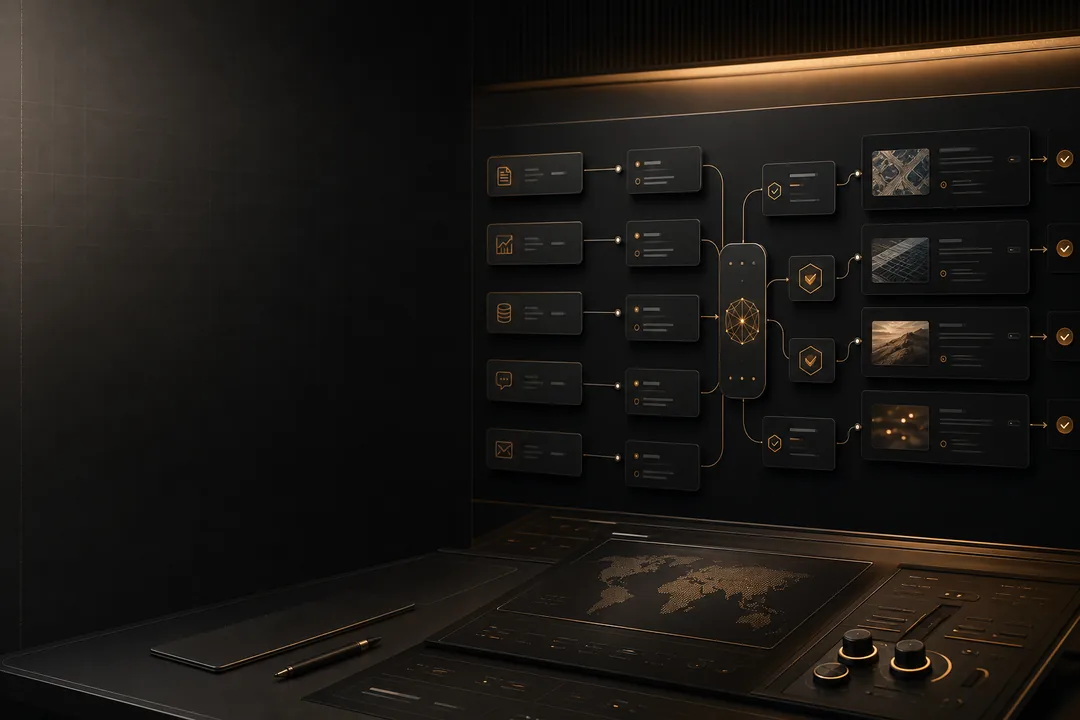
The demo looks good. The agent answers questions, drafts copy, searches documents, maybe even updates a spreadsheet. Everyone can see the potential. Then the project hits real operations and starts to wobble.
Who tells the agent what to do next? Who checks whether the answer is good enough? Who decides whether it can touch a live system? Where does the evidence go? What happens when the task needs approval?
That is where most AI projects stop being impressive and start becoming operational drag. Not because AI cannot help, but because the business has given the agent a prompt when it needed a control plane.
The prompt is not the operating system
A better prompt can improve one response. It cannot run a department.
Business work is not one clean request followed by one clean answer. It is a chain of messy handoffs: research, draft, check, revise, approve, publish, report, follow up. Along the way there are blockers, missing details, judgement calls, compliance risks, permissions, retries and human approvals.
If an AI agent is dropped into that mess with only a prompt, it will behave like a clever freelancer with no brief, no manager and no filing system. Sometimes useful. Rarely reliable.
The companies taking agentic AI seriously are not just asking which model to use. They are asking a better question: how does work move when humans and agents operate together?
McKinsey describes the shift toward the agentic organization as a new operating model where humans and AI agents work together to create value. Deloitte frames agentic AI as a future operating logic for the enterprise. IBM's governance work points to the same underlying need: controls, standards, accountability and guardrails.
Different language. Same lesson. Agents need structure.
What a control plane actually does
An AI agent control plane is the layer that turns individual agent actions into managed business work.
It does not need to be grand or complicated. In fact, the best version is usually boring.
It answers six questions:
- What work is ready to be done?
- Who or what is allowed to claim it?
- What tools and data are allowed for this task?
- What evidence must be produced?
- What checks must pass before the work moves on?
- Where does the work stop for human approval?
That is the difference between an AI assistant and an AI operating system. The assistant waits for another prompt. The operating system knows the next safe step.
The practical shape: jobs, dockets and evidence
At Foundry, the cleanest model is simple: visible jobs, bounded dockets and evidence.
A job is the business outcome. A docket is the sealed work packet underneath it. It defines the scope, the allowed actions, the forbidden actions, the inputs, the approval gate and the evidence required.
Evidence is what proves the work happened. Not "the agent said it did it." Actual proof: source lists, draft files, screenshots, scorecards, diffs, validation logs, links, comments and decisions.
This matters because AI work without evidence creates a trust problem. The agent might have done the work. It might have skipped something. It might have made something up. It might have used the wrong source. It might have crossed a boundary without noticing.
Evidence turns the agent from a black box into a worker whose output can be inspected.
The loop that makes agents useful
The useful pattern is simple:
claim, execute, verify, write evidence, update status, continue.
That loop sounds obvious. It is not how most AI deployments are built.
Most are still prompt chains. A person asks. The AI answers. The person decides what to do next. That is fine for personal productivity, but it does not scale operationally because the human remains the scheduler, checker, memory and escalation system.
A better system lets the agent claim one bounded task, produce one bounded output, verify it, log proof, update state and then pick up the next safe task. It stops only when the queue is empty, an approval is needed, a blocker is real, or a safety boundary is hit.
That is how you stop agents becoming yet another thing someone has to babysit.
Human in the loop should mean human at the right gate
"Human in the loop" is often used badly. It becomes code for "the human checks everything because the system cannot be trusted."
That is not a scalable operating model. It is manual QA with AI in the middle.
The better version is human at the right gate.
Humans should approve judgement-heavy, public-facing, financial, legal, risky or irreversible steps. They should not have to approve every harmless research summary, every local draft or every internal scorecard.
IBM's guidance around agentic AI governance points toward this: constrain the action space, require approval where needed, make actions legible, monitor behaviour, preserve attribution and allow interruption.
This is the grown-up version of AI adoption. Not "let the agent do whatever." Not "make a human approve every keystroke." The point is to put the right decision at the right point in the workflow.
Why this matters for content, SEO and AEO
Content is a perfect example because it looks easy until you run it properly.
An agent can write a blog post in one pass. That does not mean the post is useful.
A real content workflow needs source research, keyword intent mapping, positioning, drafting, fact checks, FAQ generation, internal linking, E-E-A-T checks, AI search readiness, image creation, scoring, refinement and approval before publication.
That is too much to hold in one prompt and too risky to run blind.
So the content agent should not be asked to "write a blog." It should be given a docket: find sources, summarize evidence, map keywords, draft the article, write FAQs, score the draft, refine it, produce a publish recommendation, then stop for review.
Now the output is not just a blog post. It is a reviewable content package. That is the difference between content automation and content operations.
The real test for business agents
The test is not whether an agent can complete a task once.
The test is whether it can continue through bounded work without wandering into danger.
Can it claim the next safe task? Can it produce evidence? Can it classify approval gates correctly? Can it stop when blocked? Can it recover after failure? Can it leave enough proof that a human can review the work quickly?
If the answer is yes, you have the start of an operating system. If the answer is no, you have a clever demo.
The control plane is where the value is
The market is full of tools promising more agents, smarter agents, faster agents and cheaper agents. That is not the scarce thing.
The scarce thing is operational trust.
Trust comes from knowing what the agent is allowed to do, what it actually did, what evidence it created, what changed, what did not change and where a human must step in.
This is why the next phase of AI adoption will be less about prompt libraries and more about control planes.
Not because prompts do not matter. They do. But prompts are instructions. Businesses run on systems.
If you want AI agents to do real work, do not start by asking how to make the prompt better. Start by asking how the work should move.
Then build the control plane around that.
Sources
- McKinsey: The agentic organization
- IBM: AI agent governance
- IBM: Ethics and governance landscape of agentic AI
- Deloitte: Agentic enterprise 2028
- Temporal: Durable execution
FAQ
What is an AI agent control plane?
An AI agent control plane is the operating layer that manages how agent work is assigned, checked, approved, logged and moved forward. It defines task queues, permissions, evidence requirements, approval gates and recovery rules.
Why do AI agent projects fail after the demo?
Most fail because the demo proves a task can be done once, but not that the work can run reliably inside the business. Real operations need queues, ownership, evidence, governance, approvals and recovery.
Should AI agents publish content automatically?
Not by default. Agents can prepare drafts, score content, create evidence and recommend publication, but public-facing, financial, legal, risky or irreversible actions should stop at a human approval gate.