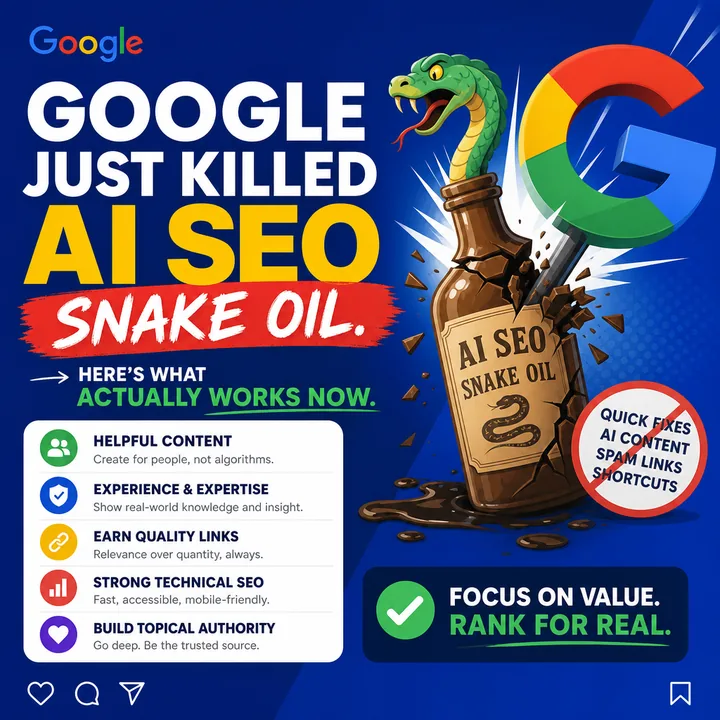
Google published something unusual this week: an official guide that basically says stop paying people to trick me.
The Google Search Central documentation on AI optimization is refreshingly blunt. AI Overviews and AI Mode are not a separate game. They are rooted in the same retrieval, ranking, and quality systems Google has used for twenty years. You are not optimizing for some new AI algorithm. You are optimizing for Google’s regular indexing and ranking pipeline. It just happens to feed AI-generated answers now.
This should be the end of the conversation. It is not.
What’s actually happening in the market
Look at what people are actually buying right now. Courses on “ranking in AI Overviews.” Services promising to get your content into ChatGPT. Consultants selling llms.txt as if it is a secret ranking hack. People building hundreds of query-variation pages hoping to manipulate AI answers.
Google explicitly says: do not do that.
The search signal from the last thirty days tells the story clearly. Reddit threads on AI SEO are full of people confused about what actually works. YouTube courses with tens of thousands of views are still teaching AEO and GEO “strategies” that Google says will not move the needle. Meanwhile, practitioners who have actually tested this report something different from what the course sellers claim.
The pages that get cited are not the ones with the most AI-optimized keywords. They are the ones that answer a specific question clearly, with first-hand evidence, original data, or real operator experience.
What Google actually said
The official guide is clear on what moves the needle:
Technical SEO still matters. Pages must be indexed, crawlable, fast on mobile, and not blocked by JavaScript issues. This is table stakes, not optional.
Non-commodity content is the strongest lever. Google explicitly favors unique, useful, expert-and-experience-led content over recycled summaries. If your page reads like every other page on the topic, it will not be retrieved. Period.
First-hand perspective beats generic lists. Reviews grounded in field experience. Original evidence. Tests you have run. Operating notes from actually doing the thing. That is what Google’s retrieval systems are designed to surface.
Query fan-out coverage without spam matters. Google may run related parallel queries to answer the user’s real intent. Your page should naturally answer adjacent questions, but not by building thin keyword-variant pages. That is scaled content abuse and Google knows it.
You do not need llms.txt, special chunking, or AI-only rewrites for Google Search. These things may help other LLMs and internal systems, but for Google Search specifically, they are not ranking signals.
The gap between what Google says and what is being sold
This is the gap that agencies like Foundry exist to bridge.
Every week, a business owner comes to us after spending money on an “AI SEO” package. They have been told that a special plugin, a series of AI-generated query pages, or an llms.txt file will get them into AI Overviews. They have spent real money on something Google has basically said does not work.
The honest answer is simpler and harder: you need pages that are genuinely useful, technically sound, and authored by people who actually know what they are talking about. That means real content, not content engineered to game a system that is not looking for what you are gaming.
This is not a satisfying answer if you wanted a quick fix. It is the correct answer.
What this means for your site this week
If you are a founder or marketing manager right now, here is what the Google guide actually means for your decisions:
- Do not pay for AI SEO snake oil. If someone is selling llms.txt or “AI Overview ranking” as a standalone service, walk away.
- Audit your content for the commodity problem. If your pages could be swapped with any competitor’s page and no one would notice, fix that first.
- Check your technical foundations. Indexability, crawlability, page speed, and mobile usability are prerequisites for any AI system to read your site.
- Measure AI Overview clicks separately. The emerging data suggests AI Overview traffic is lower volume but higher intent. Track it distinctly from standard organic.
The grift will continue until Google gets bored of saying the same thing. But the businesses that actually win in this environment are the ones that stop looking for shortcuts and start building the kind of site retrieval systems were designed to surface.
That is not glamorous. It is also not complicated.
FAQ
What is the main point of this article?
Google says AI Overviews and AI Mode still depend on the same fundamentals: crawlable pages, useful content, first-hand evidence, and technical SEO. Not shortcuts.
Why does this matter for businesses using AI?
It matters because AI is changing how buyers discover, compare and trust companies. Businesses need clear information, proof, structure and accountability so both people and answer engines can understand what they do.
What should a business do next?
Start by checking whether the relevant offer, process or proof is documented clearly on the website. Then improve the source material, add structured context, link supporting evidence and keep the page current.