
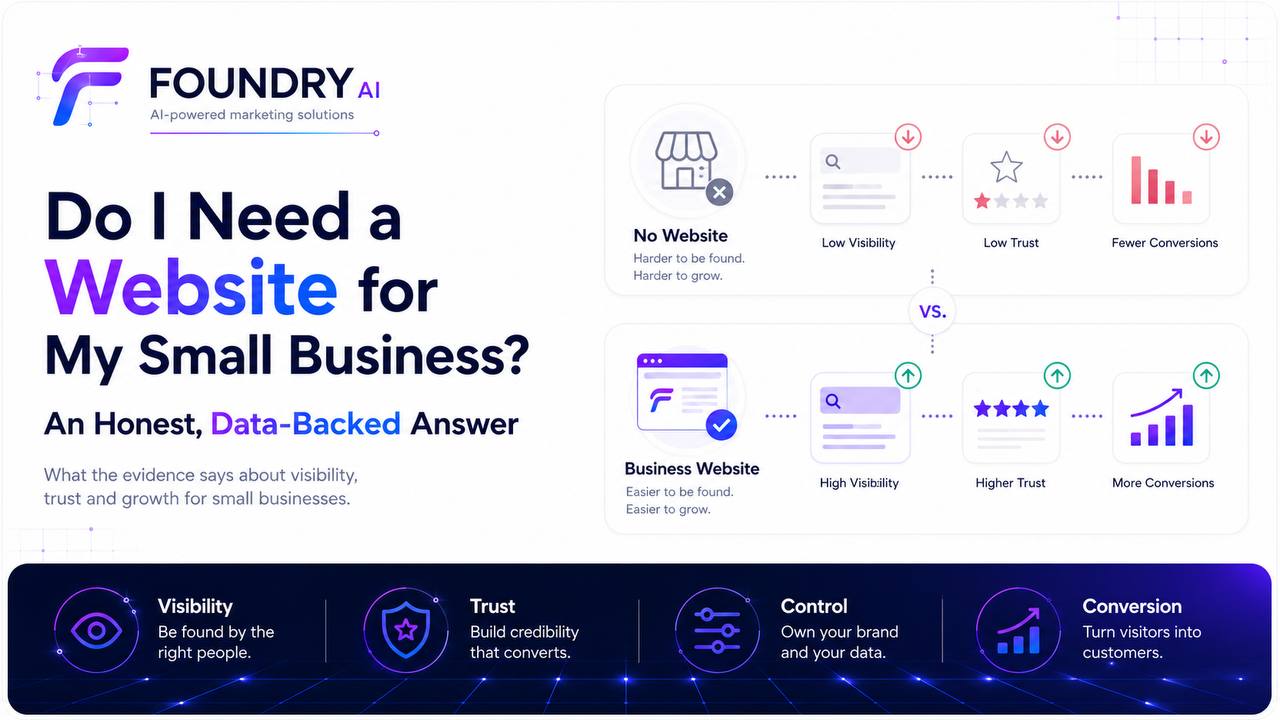
The short answer
Yes for almost every business that wants to be found — but not always. If you rely only on repeat word-of-mouth and never need new customers to check you out online, you can survive without one. For everyone else, the evidence is one-sided: consumers research online first, and BrightLocal found 54% visit a business's website after reading a good review — yet only 40% of local businesses even have one.
That last figure is worth sitting with. A lot of business advice on this topic assumes the argument's already been won — that everyone knows they need a website and the only question is what it should look like. The data suggests otherwise. There's a real, sizeable gap between businesses that have a genuine website and businesses that think a Facebook Page counts as one.
The honest exception
Let's deal with the exception first, because a blanket "yes, always" answer wouldn't be honest.
If your business genuinely runs entirely on repeat custom and personal referral — a tradesperson who's fully booked from word-of-mouth for the next year, a very local service with no ambition to grow beyond it — you can operate without a website. People will find you through the people who already know you, and a website's core job (helping new, unfamiliar customers evaluate and choose you) isn't doing much work in that situation.
But that's a genuinely narrow case, and it's worth being honest with yourself about whether it actually describes your business, or whether it's a comfortable reason not to deal with something that feels like a hassle. For almost everyone else — anyone who wants new customers, competes on being found rather than just being known, or wants some insulation from relying entirely on referrals — the case for a proper website is strong.
What the data says about how people actually decide
The starting point for most consumer research is doing exactly that: researching. A widely cited GE Capital Retail Bank study from 2013 found that 81% of consumers go online to find information and answer questions about a product or service before heading to a physical store to buy anything over $500. That figure is now more than a decade old, and consumer behaviour has only moved further online since then, not back offline — so treat it as a conservative floor, not an inflated headline.
More recent and more specific: BrightLocal's 2026 Local Consumer Review Survey found that 54% of consumers are most likely to visit a business's website after reading positive reviews about it — up sharply from 32% when the same question was asked in 2019. Reviews get someone interested; the website is where they go to confirm the decision. The same survey found that 97% of consumers read reviews for local businesses in the first place, and the average consumer checks reviews across six different sites before deciding.
Put those two findings together and a fairly clear customer journey emerges: someone hears about a business, checks reviews across several platforms, and then — more often than ever before — goes to look at the business's own website before deciding whether to buy, book, or visit. If that final step leads to nothing, or to a thin Facebook page instead of a real site, the business is asking a lot of that customer's patience.
The gap: how many businesses actually have a real website
Here's where the picture gets more interesting than the usual "you need a website" advice suggests.
In the UK, Forbes Advisor's survey work puts the figure at 78% of small business owners currently having a website, and 83.5% of those say it plays a big part in the business — so among businesses that do have one, it's genuinely valued, not just a box-ticking exercise. In the US, survey data (compiled from SCORE, Google and Clutch sources, most recently updated in February 2026) puts the share of small businesses with no website at around 27–28%.
Taken at face value, those numbers suggest the "you need a website" argument has mostly already landed — most businesses have one. But BrightLocal's 2026 survey asked a more precise question, specifically about local businesses, and specifically about a dedicated website — not a marketplace profile, not a social page, an actual owned site. The answer: just 40%.
That's a meaningfully different number from "78% have a website." The gap likely comes down to what counts. A lot of business owners who say "yes, I have a website" mean a Facebook Page, a basic listing on a directory, or a page they built once years ago and haven't touched since — none of which function the way a real, maintained, dedicated website does for a customer trying to make a decision, and none of which are reliably found by search engines or AI assistants (see our companion piece on AI visibility for the technical reasons why).
If you're not certain whether your business falls into the "has a real website" 40% or the "counts something else as a website" gap, it's worth being honest about which one you actually are.
The risk of relying only on Facebook or Instagram
Beyond the discoverability question, there's a more basic risk to running a business entirely on a social platform: you don't own it.
A Facebook Page or Instagram profile lives inside a platform you don't control. Its reach depends on an algorithm that can change overnight, without explanation, and often does. Accounts — even long-established ones with real followings — can be restricted, suspended, or disabled with little warning and limited recourse.
This isn't a hypothetical. In April 2025, the Leicester Gazette, a local news outlet in the UK, had its Facebook group and admin account disabled without a clear reason given. That group had around 1,700 members and was the outlet's second-largest source of readers — gone, during a period of local elections when that reach mattered most. The Gazette isn't unique; it's simply a documented, specific example of a structural risk that applies to any business betting its entire web presence on a platform it doesn't own.
A website doesn't carry that particular risk. It's yours — your domain, your content, your audience relationship — independent of any platform's policies or algorithm changes.
What "having a website" should actually mean in 2026
Given all of the above, "do I need a website" is really shorthand for a slightly more specific question: do you need a dedicated, owned website that's fast, genuinely readable by search engines and AI crawlers, and kept up to date — as opposed to a Facebook Page, an old site nobody's touched since 2019, or a slow, JavaScript-heavy build that looks fine to a human visitor but is effectively invisible to the systems now doing a growing share of local business discovery.
For nearly every business that wants new customers, the answer to that more specific question is yes.
What to do next
If you've read this and recognised your business in the "counts a Facebook Page as a website" category, or in the 40% gap between businesses that claim a website and businesses that have a real one, the fix doesn't need to be expensive or complicated. Hello Foundry builds a complete website — or migrates an existing WordPress site — completely free, with free hosting for life and no obligation to buy anything else.
Frequently asked questions
Can I run a small business successfully with just a Facebook Page?
For a narrow set of businesses relying entirely on repeat custom and personal referral, it's possible. For most businesses that want new customers, it's a real limitation — Facebook Pages aren't reliably readable by search engines or AI assistants, and you don't control the platform's reach or your account's continued access.
What percentage of small businesses don't have a website?
Survey estimates vary by what's counted. UK figures put around 22% of small business owners without a website (Forbes Advisor). US estimates put the figure around 27–28% (SCORE/Google/Clutch data, 2025–2026). More specifically, BrightLocal's 2026 survey found only 40% of local businesses have a dedicated website — a stricter definition that excludes social pages and marketplace listings.
Is a Facebook Page the same as having a website?
No. A Facebook Page is hosted on a platform you don't own, sits behind a login wall for much of its content, and isn't reliably crawlable by search engines or AI systems. A dedicated website is one you own and control, and can be built to be genuinely discoverable.
Do I need a website if my business only gets customers through word of mouth?
If that's genuinely and durably true — you're fully booked through referral with no plans to grow — you can operate without one. For most businesses, though, a website provides a way for new customers to find and evaluate you that referral alone doesn't reach.
Evidence sources used
The source notes supplied with this article identify the following evidence used in the draft.
- GE Capital Retail Bank Major Purchase Shopper Study, 2013 — 81% research online before a $500+ purchase (dated, attributed as such)
- BrightLocal Local Consumer Review Survey 2026, published 11 February 2026 — 54% visit website after positive reviews (up from 32% in 2019); 97% read reviews; six-site average; 40% of local businesses have a dedicated website
- Forbes Advisor UK survey — 78% of UK small business owners have a website; 83.5% say it plays a big part
- Rudy's, February 2026, citing SCORE/Google/Clutch — 27–28% of US small businesses have no website (cited as directional survey data; the associated "39% more revenue" claim is explicitly excluded as weak)
- Leicester Gazette Facebook account disabling, April 2025 (documented case)
Free Website Programme
A properly branded small-business website. £0 build. £0 supported static hosting.
You buy and own the domain. Hello Foundry builds the agreed standard site, including SEO and AI-readable foundations, and hosts it for £0 while it remains on our supported static stack.