
The short answer
A UK small-business WordPress site typically costs £300–£1,200 a year to run before you pay for anyone's time — hosting, premium plugin renewals, security and backups — and £600–£10,000+ a year once you add maintenance. Over three years that's often £3,700–£13,000.
Most of that cost is invisible on day one. WordPress itself is free and open-source, which is exactly why so many small businesses choose it — the up-front price looks unbeatable. But a working small-business website is never just WordPress. It's WordPress plus hosting, plus a handful of premium plugins to do the things WordPress doesn't do out of the box, plus security tools, plus someone's time to keep it all patched and working. Add those up over a few years and the "free" platform turns out to be one of the more expensive ways to run a small website.
The full cost breakdown
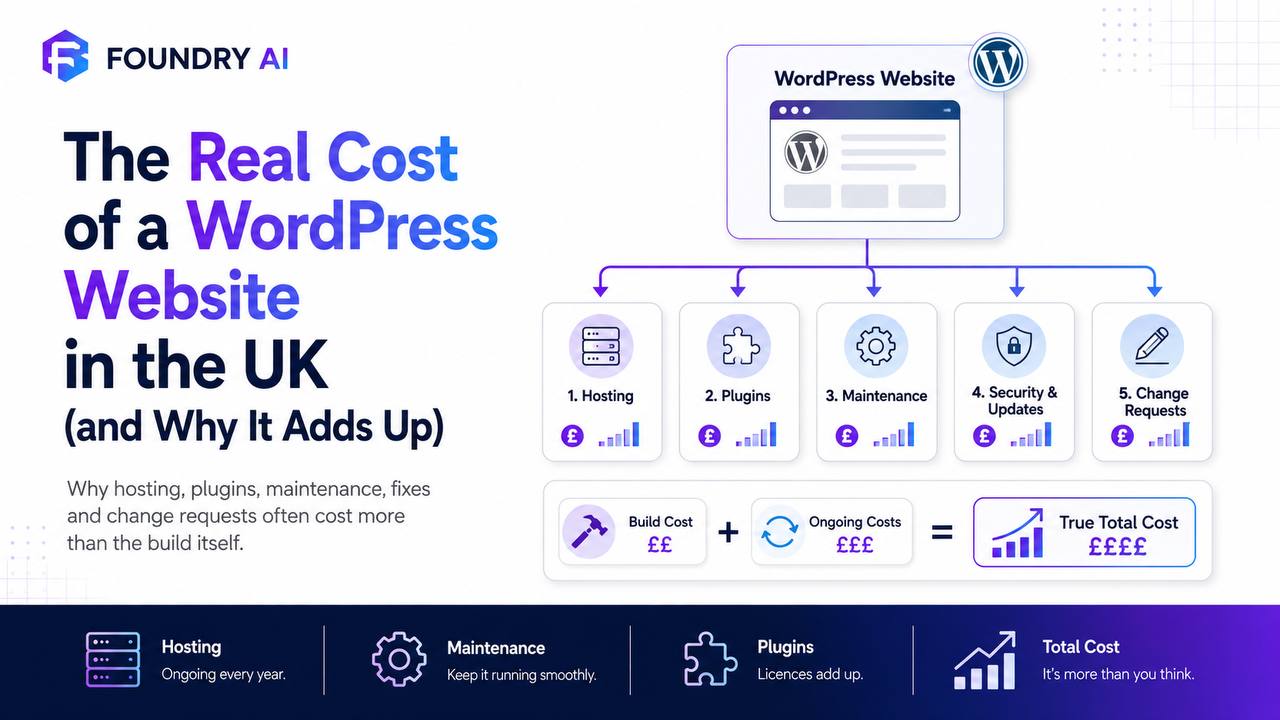
Here's what actually goes into a typical UK small-business WordPress site's running costs, based on current published pricing:
- Hosting: £36–£720 per year, depending on whether you're on shared, managed, or higher-tier hosting.
- Domain: £10–£15 per year — the one cost that's roughly the same whatever platform you're on.
- Premium plugins: £100–£400 per year in renewal fees for the paid plugins most small-business sites end up needing — form builders, SEO tools, page builders, booking systems, and similar.
- Security tools: £0–£300 per year, depending on whether you're using a free security plugin or a paid service with active monitoring.
That's before anyone's time is involved. Add outsourced maintenance — someone actually keeping the site updated, patched, and working — and the picture changes considerably. Typical outsourced WordPress maintenance in the UK runs £50–£150 a month for a fairly basic package, rising to as much as £700 a month for full support with faster response times and more hands-on management.
The three-year number, not the sticker price
The reason WordPress's true cost catches people out is that it's rarely presented as a running total. "WordPress is free" is technically accurate and practically misleading, because nobody runs a bare WordPress install with no hosting, no plugins, and no maintenance.
Looked at over a realistic three-year period — long enough to see the pattern of renewals, plugin updates, and at least one round of maintenance work — published UK cost estimates put a typical WordPress small-business site at somewhere between £3,736 and £12,935 or more, depending on how much is outsourced versus handled in-house. A business paying what looks like a modest £70 a month for hosting, but £800 a month for maintenance, is quietly paying more than £10,000 a year — a number that rarely appears on the invoice for the original build.
None of this makes WordPress a bad platform. It makes it a platform with a genuinely different cost shape to what the free, open-source label suggests — low upfront, then a steady accumulation of smaller recurring costs that add up faster than most business owners expect.
Why WordPress carries this cost structure
The reason isn't incompetence on WordPress's part — it's a direct consequence of how the platform is built. WordPress's flexibility comes from its plugin ecosystem: tens of thousands of add-ons that let a WordPress site do almost anything. That flexibility is genuinely valuable, but it comes at a price, in two senses.
First, the paid version of "almost anything" usually costs money — most of the plugins that make a WordPress site actually competitive (proper SEO tools, decent form handling, page builders, booking systems) have a premium tier, and premium tiers renew annually.
Second, every plugin is also a piece of software that needs updating, that can conflict with other plugins, and that can introduce a security vulnerability. The more a site relies on plugins to do its job, the more surface area there is to maintain — which is exactly why maintenance retainers exist as a category of service in the first place.
The security dimension
This isn't a marginal concern. According to Patchstack's State of WordPress Security 2025 report, the WordPress ecosystem saw 7,966 new vulnerabilities disclosed in 2024 — up 34% on the year before, and working out to roughly 22 new vulnerabilities a day across the ecosystem. The overwhelming majority — 96% — were found in plugins, not WordPress core itself (which accounted for just 4% of vulnerabilities). Of the vulnerabilities identified, 43% were exploitable without any authentication at all, meaning an attacker didn't need a login to exploit them.
That 96%-in-plugins figure matters for the cost conversation specifically: it's the plugin ecosystem that gives WordPress its flexibility, and it's the same plugin ecosystem that generates the overwhelming majority of its security exposure — which is a large part of why ongoing maintenance and security monitoring aren't optional extras for a WordPress site, they're close to a requirement.
Where WordPress still earns its cost — the honest counter-case
None of this means WordPress is the wrong choice for every business, and it would be dishonest to argue otherwise. WordPress genuinely earns its running cost in a few specific situations:
- Complex or large-scale ecommerce. WooCommerce, WordPress's ecommerce plugin, is mature and capable of handling genuinely complex catalogues, inventory, and checkout flows that a simpler static site isn't built for.
- Non-technical, hands-on daily editing. If you or your team want to log in and edit pages, publish posts, and manage content constantly without involving a developer, WordPress's admin interface is a known quantity that a lot of people are already comfortable with.
- Existing deep plugin dependencies. A business with a membership system, a learning management setup, or a complex booking flow already built on specific WordPress plugins has real switching costs — rebuilding that functionality elsewhere isn't free either.
If your business genuinely fits one of those categories, WordPress's cost may be a reasonable price for what you're getting. The point of this piece isn't that WordPress is bad — it's that the running cost is real, recurring, and usually much higher than the "it's free" pitch suggests, and it's worth going in with your eyes open.
The alternative: near-zero recurring cost with a static-first build
For a large share of small-business websites — brochure sites, service pages, portfolios, local business sites that don't need complex ecommerce or a constant stream of self-edited content — a static-first build on a modern framework avoids most of this cost structure entirely. There's no PHP interpreter or database to secure, no plugin ecosystem generating a steady stream of vulnerabilities, and hosting on a platform like Cloudflare Pages, Netlify, or Vercel can run at near-zero recurring cost beyond the domain itself.
That's a genuinely different economic shape: instead of a low upfront cost and a rising recurring one, it's closer to a fixed, low-or-no-recurring cost from the start. Whether that trade-off makes sense depends on what the site actually needs to do — which is exactly what our companion piece on Astro vs WordPress goes into.
What to do next
If your current WordPress site is costing more than you'd like once hosting, plugins, security, and maintenance are all added up, it's worth working out your actual three-year number before deciding what to do about it. Hello Foundry rebuilds — or migrates — small-business websites for free, with free hosting for life and no obligation to buy anything else.
Frequently asked questions
How much does a basic WordPress website cost to run per year in the UK?
Before any maintenance labour, typically £300–£1,200 a year across hosting, domain, premium plugins, and security tools. Add outsourced maintenance and the realistic annual figure is often £600–£10,000+, depending on how much support is involved.
Why is WordPress described as free if it costs this much?
WordPress software itself is free and open-source. The cost comes from everything around it that a working small-business site needs — hosting, premium plugins for functionality WordPress doesn't include natively, security tools, and ongoing maintenance to keep everything patched and working.
Is WordPress less secure than other platforms?
WordPress's security exposure comes overwhelmingly from its plugin ecosystem — 96% of vulnerabilities disclosed in 2024 were in plugins, not WordPress core, according to Patchstack. A platform with no equivalent plugin ecosystem, such as a static site, has a fundamentally smaller attack surface by design, though it also can't offer the same breadth of add-on functionality.
Is WordPress ever the right choice despite the cost?
Yes. WordPress remains a strong choice for complex or large-scale ecommerce, businesses that need frequent hands-on self-editing without a developer, and sites with deep existing plugin dependencies. The cost is a reasonable trade-off if your business genuinely needs what WordPress provides.
Evidence sources used
The source notes supplied with this article identify the following evidence used in the draft.
- ProfileTree, 2026 — UK hosting £36–£720/yr, domain £10–£15/yr, plugins £100–£400/yr, security £0–£300/yr
- EdTheDev, Nadja Eberhardt, Rudo, 2026 — outsourced maintenance £50–£150/month typical, up to £700/month
- Splendid Web, 2026 — 3-year WordPress TCO typically £3,736–£12,935+
- Rudo, UK, 2026 — worked example of £70/month hosting + £800/month maintenance = £10,000+/yr
- Patchstack State of WordPress Security 2025 — 7,966 vulnerabilities disclosed in 2024 (+34% YoY), 96% in plugins, 4% in core, 43% exploitable without authentication
Free Website Programme
A properly branded small-business website. £0 build. £0 supported static hosting.
You buy and own the domain. Hello Foundry builds the agreed standard site, including SEO and AI-readable foundations, and hosts it for £0 while it remains on our supported static stack.